


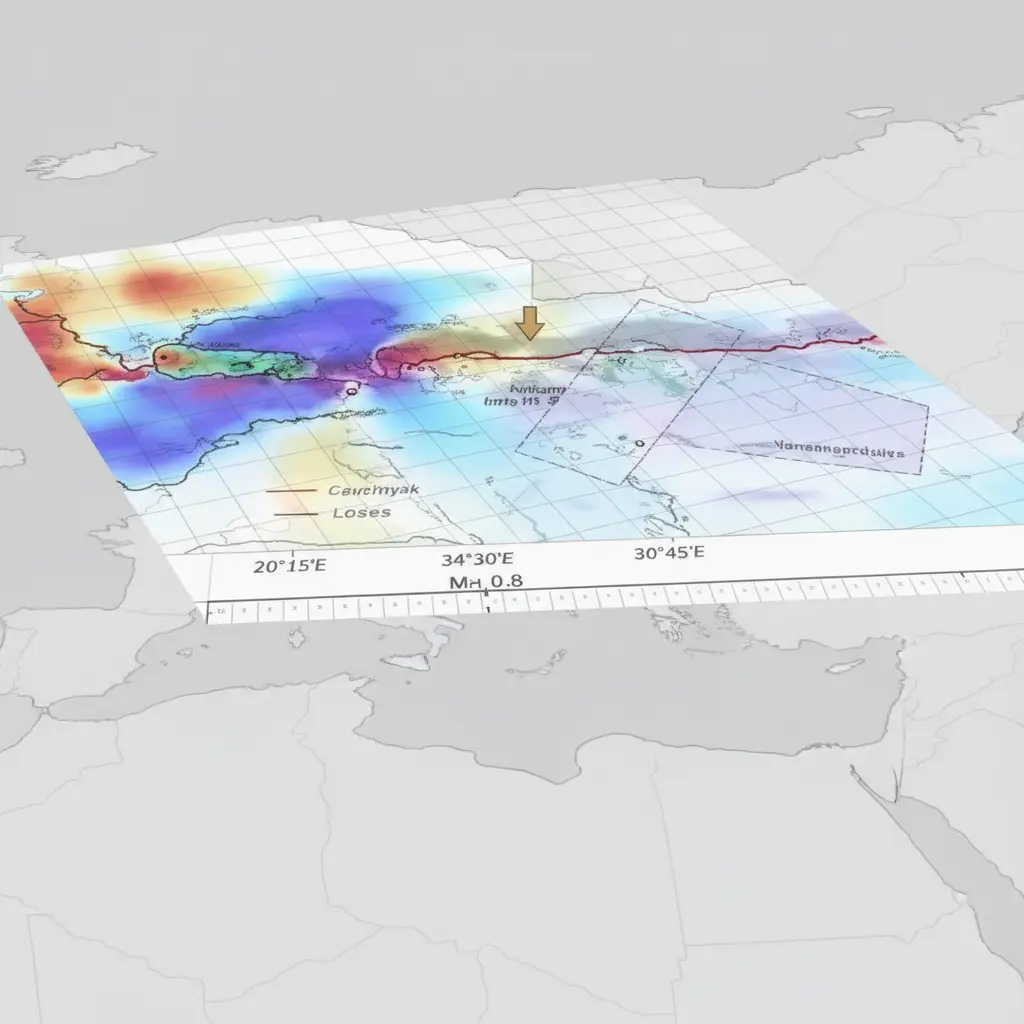
A recent study published in the prestigious scientific journal Science has sent a chilling warning to Istanbul: earthquakes in the Sea of Marmara have been systematically progressing from west to east, effectively marching towards the city’s doorstep over the past 15 years. This revelation, stemming from a detailed analysis of the Main Marmara Fault (MMF) by an international research team, suggests that the region, already identified as Europe’s highest earthquake risk zone, is facing an escalating threat.
The ‘Domino Effect’ Approaching Istanbul
The research, conducted at Germany’s GFZ Helmholtz Centre for Geosciences, meticulously examined seismic activities along the MMF in recent years. The most striking finding indicates a chain reaction of earthquakes migrating eastward. Seismic activity commenced in the western and central parts of Marmara in 2011-2012. This was followed by the 5.8-magnitude Silivri earthquake in September 2019. Most recently, a 6.2-magnitude earthquake in April 2025 occurred just east of the 2019 event, significantly closer to Istanbul.
Scientists interpret this pattern as the ‘creeping’ (active) western segments of the fault pushing and loading the ‘locked’ (immobile and energy-accumulating) eastern segments directly south of Istanbul. This systematic progression paints a grim picture for the city, which has long lived under the shadow of a potential major earthquake.
Fault Line Stressed, Not Relieved: The Mechanics of Shear Stress
Typically, an earthquake is expected to relieve stress on a fault line, followed by aftershocks. However, analyses for the Marmara region reveal a different, more alarming scenario. While the stress level (b-value) on the fault line had returned to normal after the 5.8-magnitude earthquake in 2019, the expected relief did not occur after the 6.2-magnitude earthquake in April 2025.
Instead, analyses indicate that the shear stress in that region remains exceptionally high. Shear stress refers to the internal forces within a material where layers are forced to slide in opposite directions. The North Anatolian Fault (NAF) is a ‘strike-slip’ fault, meaning two massive landmasses rub past each other horizontally. This friction causes immense locking, but the Earth’s crust continues to move, building up continuous pressure. This pressure is what scientists call shear stress, and its persistence suggests the fault may be primed for a new, larger rupture.
Potential for Unforeseen Severity in Istanbul
The study also confirmed that the ‘rupture direction’ of both the 2019 and 2025 earthquakes was eastward. This technical detail has profound implications for Istanbul residents: when the fault ruptures eastward, seismic waves and ground motion energy are focused like a lens towards Istanbul. This means that in a future potential earthquake, the city could experience ground shaking far more severe than what would be expected based on the earthquake’s magnitude alone. Measurements from past events showed stronger ground motion and acceleration towards Izmit Bay and the Armutlu Peninsula. If a larger earthquake in the future ruptures from west to east, it could significantly amplify the shaking in Istanbul.
The ‘Seismic Gap’ and the Adalar Fault: A Critical Zone
The paper also identifies a currently critical area. Between the end point of the April 2025 earthquake and the Istanbul Adalar fault, off the coast of Avcilar, lies an approximately 15-20 kilometer ‘silent’ section, or seismic gap. This small segment could be the candidate for the next 6.0-magnitude or larger earthquake. Scientists warn that this silent segment could trigger the adjacent Princes’ Islands (Adalar) segment to its east, which is entirely locked and accumulating a vast amount of energy.
Europe’s Highest Earthquake Risk: The Marmara Sea
The Marmara Sea is, according to researchers, Europe’s highest seismic hazard zone. In this region, where the Anatolian Plate slides against the Eurasian Plate at a rate of 17 to 29 millimeters per year, a significant portion of the NAF, approximately 1200 kilometers, ruptured in the 20th century. However, the main fault line within the Sea of Marmara – the Main Marmara Fault (MMF) – has largely remained unruptured.
Historical records indicate that Istanbul has experienced multiple earthquakes of magnitude 7 or higher over the past 2,300 years, with major events occurring in 1509, 1766, and 1894. Previous studies estimated a 35% to 47% probability of a 7.3-magnitude earthquake near Istanbul within 30 years.
Conclusion: Increased Risk, Urgent Monitoring
The scientists conclude their article with a stark warning: the April 2025 earthquake released only a very small fraction of the energy accumulated since 1766 (approximately 20 centimeters of movement), whereas the accumulated deficit is about 6 meters. This eastward pressure and rupture effect have significantly increased the risk for Istanbul. Researchers emphasize that continuous, second-by-second monitoring of the fault with new seabed sensors is of vital importance.
Expert Opinions: A Consensus on Impending Danger
Judith Hubbard, a seismologist from Cornell University not involved in the study, shared her views with the New York Times, stating, “A very large earthquake near Istanbul could lead to one of the heaviest humanitarian disasters in recent history.” While the exact reason why earthquakes sometimes propagate along a fault in this manner is not entirely clear, it has been observed on the North Anatolian Fault in the past. However, Hubbard also cautions that the researchers’ latest analysis only includes four moderate-sized earthquakes, which might not be sufficient to establish a clear pattern. “There’s also a pretty good chance that these are just ordinary earthquakes that just happen to look like they’re migrating,” she said. “We still can’t tell if this earthquake will come with a migrating sequence of earthquakes, as implied in this paper, or if it will happen suddenly.” Nevertheless, there is a consensus that dangerous stress is accumulating on this fault, meaning a large and destructive earthquake is almost certainly expected.
Source: https://tr.euronews.com/next/2025/12/13/uluslararasi-arastirmacilardan-istanbul-uyarisi-depremler-adim-adim-sehre-yuruyor