

Ankara Metropolitan Municipality Unveils ‘Ankara 2050 Environmental Master Plan’
Ankara, February 1 – The Ankara Metropolitan Municipality (ABB) officially presented its 1/100,000 scale Environmental Master Plan (ÇDP), designed to guide the city’s development until 2050, at a public introductory meeting held yesterday. Mayor Mansur Yavaş, addressing the attendees, characterized the plan as ‘the greatest service and legacy left for the future’, emphasizing its comprehensive nature and collaborative development with all stakeholders.
A Holistic Approach to Urban Planning
The ‘Ankara 2050 Environmental Master Plan’, spearheaded by the Department of Zoning and Urbanization, seeks to put an end to the fragmented planning approaches of the past. Its primary objective is to protect and enhance Ankara’s natural, cultural, and economic assets through a sustainable development framework. This initiative marks a significant shift towards a more integrated and forward-looking urban strategy for the capital.
Over 600 Stakeholders Converge for Transparency and Participation
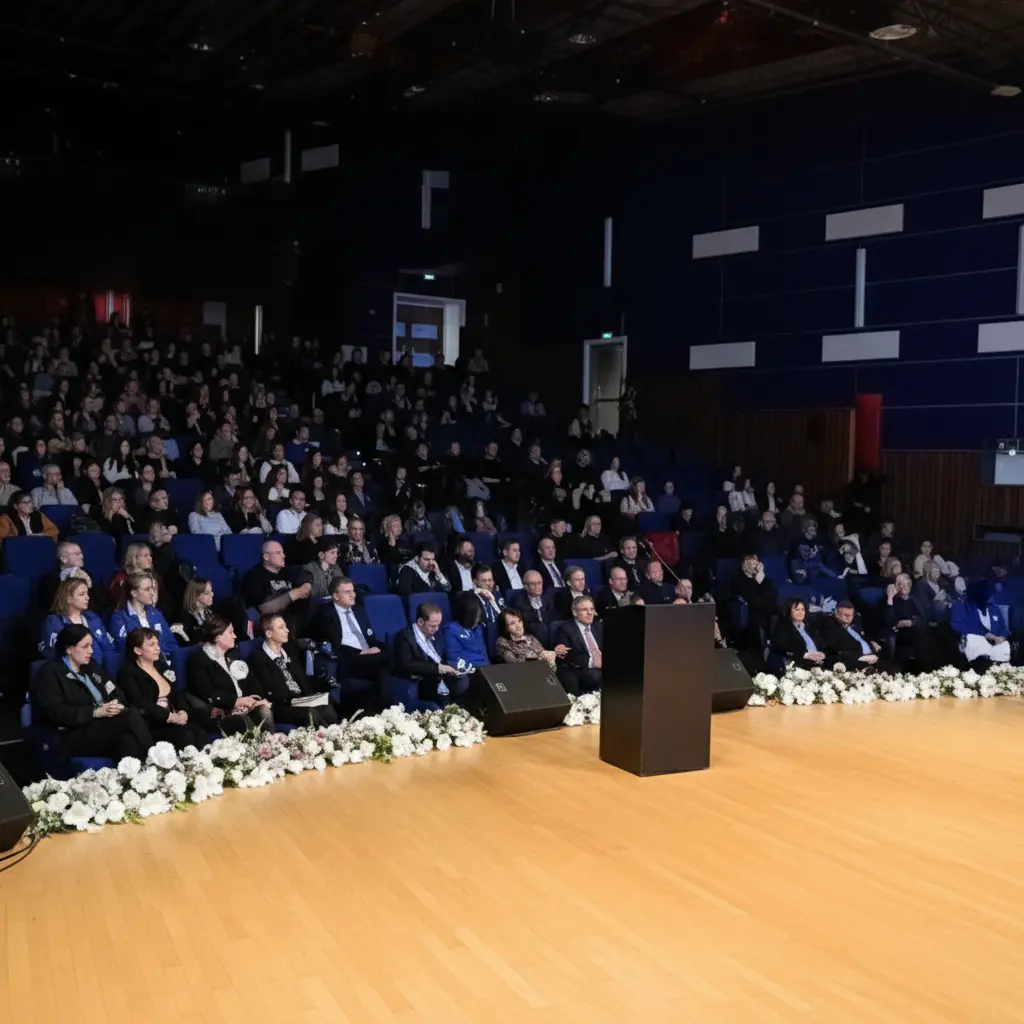
The introductory meeting, held at the Kocatepe Cultural Center, underscored the principles of transparency and participatory planning. It gathered a diverse group of over 600 representatives from 55 different stakeholder institutions. Attendees included Ankara Members of Parliament Semra Dinçer, Aylin Yaman, and Aliye Timisi Ersever, district mayors, Metropolitan Municipality Council members, public institutions, local administrations, universities, academic circles, professional chambers, and various non-governmental organizations. The session provided a detailed overview of the preparatory work and the planning model adopted for the Environmental Master Plan.
Mayor Yavaş Criticizes Past Rent-Seeking Practices
In his opening speech, ABB Mayor Mansur Yavaş strongly criticized past rent-driven zoning plans, citing examples from Dodurga, Alacaatlı Mahallesi, İncek, and Ovacık. He referenced a previous social media post titled ‘How a City is Slaughtered’, highlighting the detrimental effects of such practices. Yavaş recalled discussions from 2004 regarding the Metropolitan Law, which aimed for a unified planning approach. He lamented that despite this intention, numerous entities independently approved zoning plans, often circumventing the Metropolitan Municipality. ‘Those seeking rent went to some public institutions to get plans approved, bypassing us. We only have the right to object to these and take them to court. However, when this law was made, there was supposed to be a single, holistic plan. From the structure of buildings to the architectural texture, everything was supposed to be common. It is clear that this did not work out,’ Yavaş stated.
He continued by providing examples of past zoning rents that have been subjects of controversy, emphasizing the critical importance of the new plan: ‘If the Environmental Master Plan is finalized by our Metropolitan Municipality Council with unanimous approval, it will at least bind all of us, and we will not encounter these issues again. We believe that if the work is done in accordance with technical and scientific principles, it will largely resolve the problems that may arise in the future. Therefore, I attach great importance to this plan.’
‘The Greatest Legacy for the Future’
Mayor Yavaş extended his gratitude to the public institutions, universities, and non-governmental organizations that sent representatives to the ÇDP meeting. He concluded his speech by saying: ‘This plan means nothing if these institutions do not participate. Tomorrow, with a small change in the law, they can proceed without complying with the Environmental Master Plan we have created. I believe that this will be the greatest service, the greatest legacy we will leave for the future, for the year 2050. Especially for this work, our non-governmental organizations and universities have kindly sent many representatives. With their contributions, the contributions of our Municipality, the public institutions with zoning authority, and our universities, I hope we will succeed in this endeavor. I extend my endless thanks to everyone who participated and contributed. May it be beneficial for our Ankara.’
ÇDP Aims to Solve Chronic Urban Problems
Ertuğrul Candaş, Head of the ABB Department of Zoning and Urbanization, stated that the ÇDP aims to provide lasting solutions to Ankara’s chronic urban and rural problems. He noted that the previous ÇDP, targeting 2038, was deemed unfit for the capital and was annulled by a court decision due to its inconsistency with urban planning principles. ‘In line with the new management approach in the capital Ankara, an opportunity arose to conduct an exemplary planning study that is participatory, transparent, sensitive to natural and cultural values, and based on scientific knowledge. For this very reason, the court’s annulment decision was not appealed, and it was decided to create a new plan in line with the vision of our President Mansur Yavaş,’ Candaş explained.
‘The 2050 Environmental Master Plan, which we are presenting to your knowledge today, was an urgent and indispensable need for our capital. We needed a properly crafted Urbanization Constitution. Within the scope of the Environmental Master Plan preparation process, a large and strong planning team was formed within our municipality,’ he added.
Prof. Dr. Savaş Zafer Şahin Presents ÇDP Model
During the meeting, Prof. Dr. Savaş Zafer Şahin, a faculty member at Ankara Hacı Bayram Veli University and Vice President of the Ankara City Council, delivered a comprehensive presentation on the planning model. Starting with the emphasis on ‘Planning is an effort to shape a common future under uncertain conditions’, Şahin discussed current debates in global large-scale planning, Ankara’s planning practices from its designation as capital to the present, contemporary approaches in this process, Ankara’s planning challenges, and the ÇDP process including the conducted studies, the principle of participation, communication design, and the open data approach.
Şahin underscored the necessity for other planning efforts, such as those concerning climate, transportation, and environment, to be carried out concurrently and in coordination with the ÇDP. He elaborated: ‘It is very important to collaborate with professional chambers, university professors, non-governmental organizations, and structures like the city council, and we must build an architecture for this. In this way, while preparing scenarios for the city’s needed development pattern, we will also develop a tool that can address human-nature-city relations in a healthy framework. This is a process that will start with environmental planning and will never end; it will continue with plans extending down to the neighborhood scale. We are still at the beginning of the process, but we have made significant progress. Planning begins with planning how to plan the plan.’
The program concluded with a Scientific Advisory Board Panel.
Source: (KAHA) Kapsül Haber Ajansı