


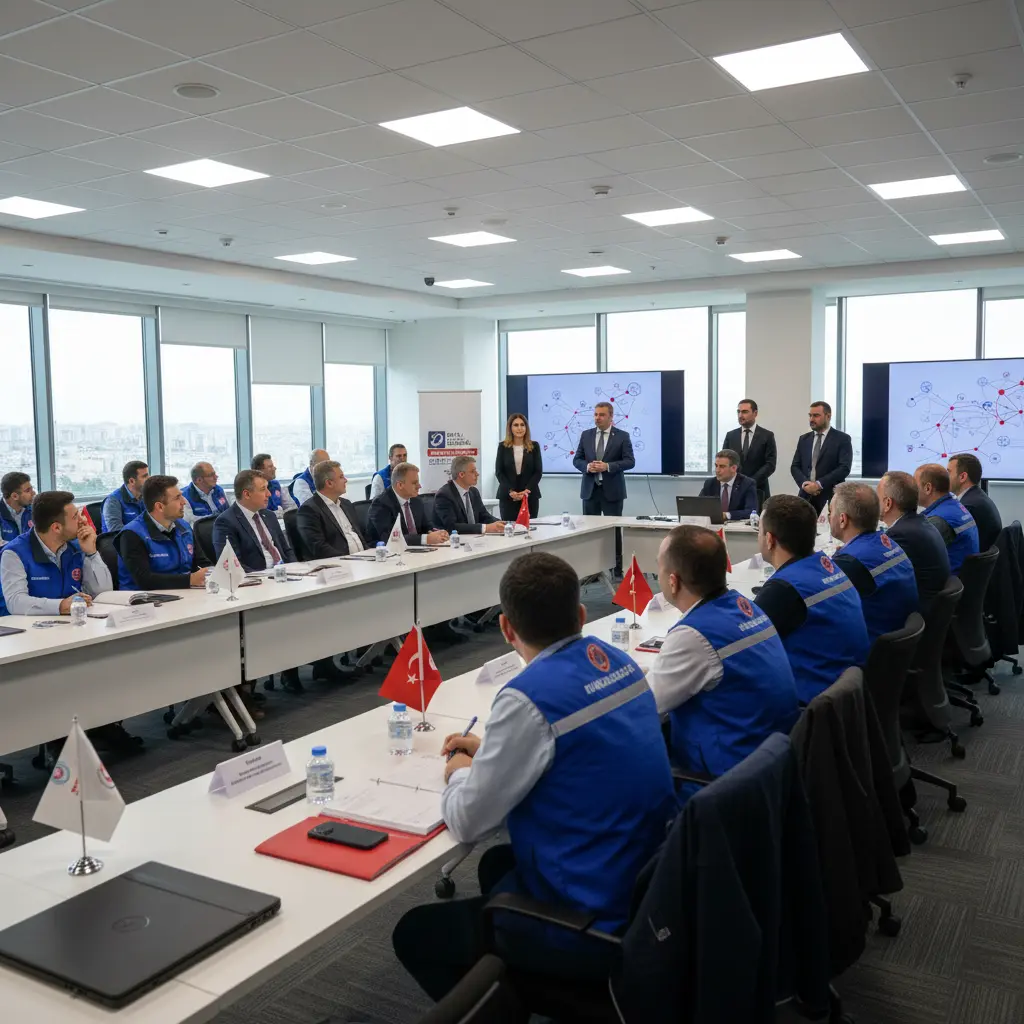
“Disaster Health Team National Accreditation Guideline Workshop” Held in Ankara
Ankara, April 8 – A workshop focusing on the “Disaster Health Team National Accreditation Guideline” was successfully conducted in Ankara. The workshop was presided over by Ali Hamza Pehlivan, President of the Disaster and Emergency Management Authority (AFAD), and saw the participation of relevant unit managers from AFAD, representatives from non-governmental organizations active in the health sector, and private institutions.
Finalizing the Guideline for Enhanced Disaster Response
The workshop commenced with opening and evaluation speeches by President Pehlivan. During the sessions, the final views, contributions, and suggestions regarding the “Disaster Health Team National Accreditation Guideline” were thoroughly reviewed. This guideline was prepared by the General Directorate of Emergency Health Services of the Ministry of Health, a key solution partner in the Turkey Disaster Response Plan (TAMP), in close coordination with the AFAD Presidency.
It was noted that the AFAD accreditation system aims to ensure coordination among institutions, organizations, and civil society groups operating in service areas under TAMP. Furthermore, it seeks to define service standards, enhance service quality, and ensure the continuity of quality in disaster response efforts.
AFAD’s Extensive Accreditation and Volunteer Programs
To date, the AFAD Accreditation System has accredited 531 teams and 17,685 members from public institutions, NGOs, and private organizations across various fields. These include urban search and rescue, nutrition, in-kind donation and warehouse management and distribution, psychosocial support, disaster and emergency training, emergency sheltering in disasters, field search and rescue, and search and rescue in floods and rivers.
The AFAD Volunteer System has also seen significant engagement, with 1,644,211 citizens registering as AFAD volunteers. Among them, 368,401 volunteers have completed their online training, and 83,031 out of 285,370 basic AFAD volunteers have earned the right to become support AFAD volunteers after completing face-to-face training.
AFAD’s Role in Integrated Disaster Management
In his remarks, AFAD President Pehlivan emphasized that AFAD serves as a coordinating body. He highlighted that since its establishment in 2009, the presidency has been conducting disaster-related activities in line with an integrated disaster management approach. Pehlivan stated that risk reduction, response, and recovery efforts are carried out cohesively and according to a plan. He further explained that the Turkey Disaster Risk Reduction Plan (TARAP) addresses risk reduction, TAMP covers response, and the Turkey Post-Disaster Recovery Plan (TASIP) deals with recovery efforts, all approached in a planned, coordinated, systematic, and integrated manner.
Pehlivan also pointed out the global increase in the number, type, frequency, severity, and impact of disasters, necessitating an international understanding and unified application in disaster management and response. He underscored Turkey’s membership in relevant organizations established under the United Nations, in addition to regional cooperation organizations. He affirmed that preparation activities, plans, and implementation details concerning disaster response are closely monitored and shared with all state institutions, organizations, and civil society organizations.
Pehlivan concluded by stating that the AFAD Accreditation System has transformed disaster management into a modern, professional, and world-standard institutional structure.