

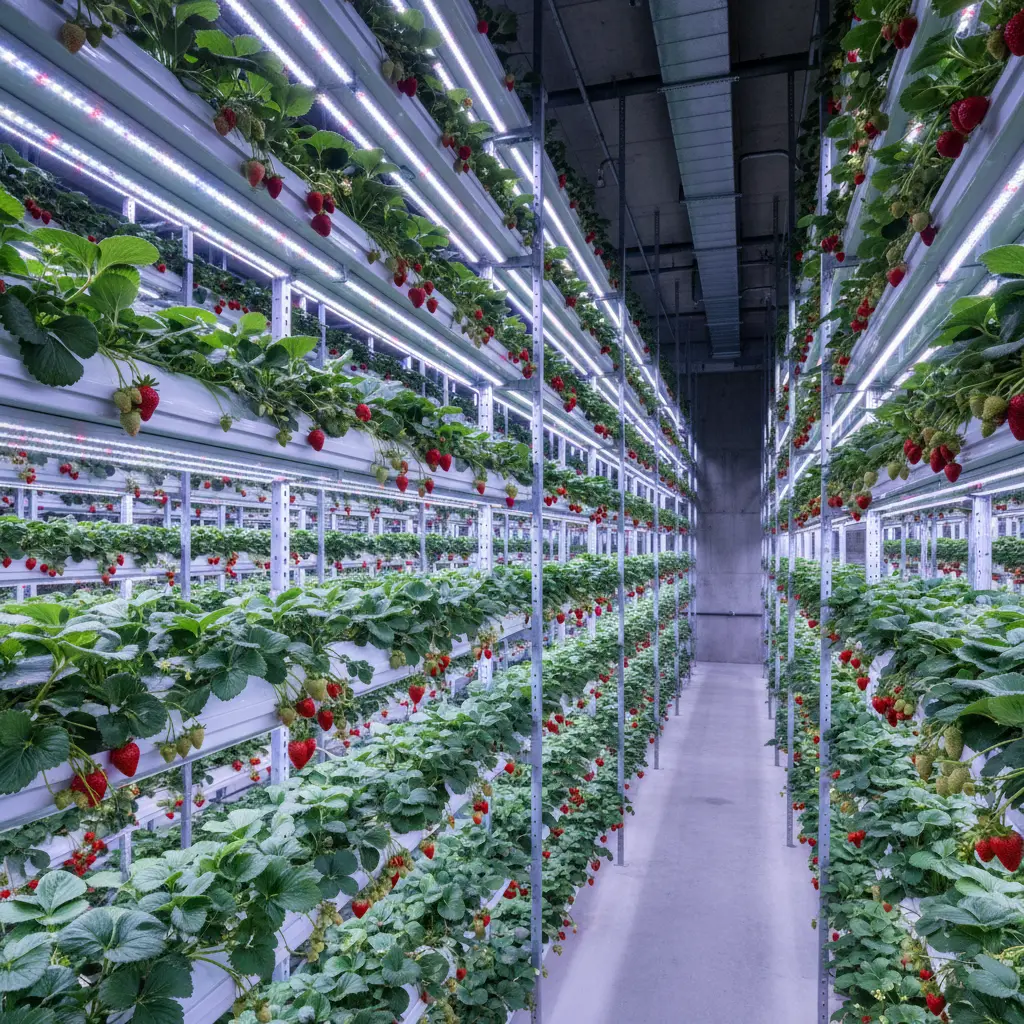
Istanbul, 25 April 2026 – The Istanbul Indoor Vertical Farming Application Center, operating 30 meters below ground in a cultural center in Kağıthane, has begun efforts to produce strawberries year-round using vertical farming methods. This facility, recognized as the world’s second-deepest agricultural production center, already cultivates 120 different plant species through soilless farming.
Pioneering Fresh Produce for Istanbul
The center, affiliated with the Istanbul Provincial Directorate of Agriculture and Forestry, is dedicated to cultivating fresh and healthy vegetables for the city’s inhabitants. Its latest initiative focuses on the continuous, high-quality, and pesticide-free production of strawberries.
Hakan Aşan, an agricultural engineer and Project Coordinator at the Istanbul Indoor Vertical Farming Application Center, stated that since 2022, they have conducted extensive R&D on approximately 120 different plant varieties. They have determined the optimal parameters for their cultivation and compiled them into a catalog, which they share with potential investors and stakeholders.
Soilless Farming: A Sustainable Solution
Aşan explained that the facility employs hydroponic water culture, a soilless farming technique. “We have plant growth lights that simulate sunlight. By organizing all parameters according to the plant’s needs, we rapidly produce healthy, nutrient-rich, and pesticide-free products. We can achieve this production right in the heart of Istanbul,” he noted.
Products from the center are supplied to markets, restaurants, and hotels. Aşan highlighted the numerous advantages of their production method:
- Pesticide-free: The controlled environment eliminates the need for agricultural pesticides.
- Fresh and nutritious: High-quality produce is grown centrally, reducing logistics costs.
- Water efficiency: They use only 1 liter of water to produce 1 kilogram of lettuce, compared to 250 liters in traditional farming and 20 liters in automated greenhouses, achieving 99.6% water savings.
The facility boasts three production units and one seedling room. “In a total area of 300 square meters, we achieve production equivalent to 20,000 square meters of field farming. This significant efficiency advantage is due to our use of multi-layered and vertical spaces, maximizing yield per unit area,” Aşan stated. He added that the ability to control the climate allows for 12 months of continuous production, providing commercial advantages for year-round supply commitments.
Predictable Yields and Climate Resilience
Aşan emphasized that the application results in predictable yields, independent of climatic conditions. “There is no risk of disease. You are not subject to any climatic risks like drought or hail. Provided everything is done correctly, the yield, product quantity, and quality are known from the outset. This is one of its biggest advantages,” he said.
Comparing vertical farming to traditional field farming, Aşan noted, “Field farming requires many workers. Here, we manage approximately 300 square meters of production area with just three people. For example, field cultivation of Italian basil takes 75 to 90 days. We achieve the same biomass and yield in 22 days.”
He further explained, “Because we provide the ideal spectrum of nutrients and growth lights for photosynthesis, and adjust climate, temperature, humidity, and carbon dioxide to optimal conditions, the plant reaches its full potential rapidly without any stress. We conduct numerous experiments with different plant varieties and parameters to determine the point at which we achieve the highest nutritional value. In terms of nutritional value, vertically farmed products can be considered superior to those grown in soil, being healthier and pesticide-free. They are also free from dust, so you can eat them without washing.”
Impact and Future Plans
In 2025, the facility welcomed over 10,000 visitors, with approximately 7,000-8,000 being students. Aşan noted, “We support those who visit and wish to develop themselves in this field. We assist TEKNOFEST teams in agricultural technologies. Inspired by our work, 3-4 commercial vertical farming facilities have opened in Istanbul, employing our trained personnel.”
Aşan mentioned that they test both local and foreign seeds, with about 80% of their current seeds being local. He also highlighted the upcoming strawberry production initiative: “Indoor vertical farming of strawberries will be continuous for 12 months, producing high-quality, pesticide-free strawberries directly in the heart of Istanbul without logistical costs. We have started the R&D, and we plan to complete it within approximately 6 months.” They will also develop high-quality production recipes for strawberries.
Source: Anadolu Agency, Istanbul Provincial Directorate of Agriculture and Forestry