


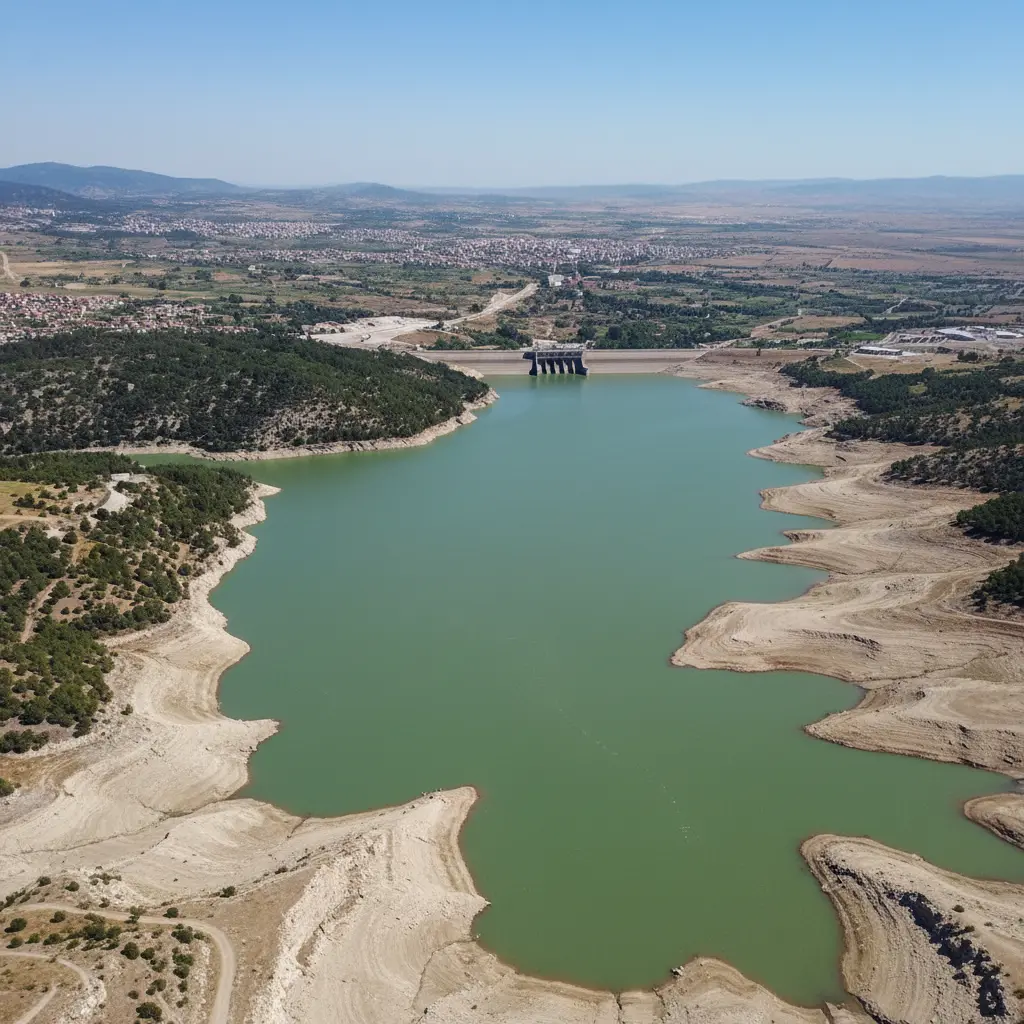
Ankara, Turkey – The water levels in Ankara’s dams continue to be at a critical juncture, with recent data revealing a deepening crisis. According to the Dam Information System, as of January 21, 2026, the total occupancy rate of the dams stood at a mere 12.60%. This represents a significant decline compared to the 28.88% recorded on the same date last year.
Alarming Drop in Usable Water Reserves
Despite a total dam capacity of 1 billion 585 million cubic meters, the current water volume in the dams is reported to be only 199 million cubic meters. More concerning is the active usable water level, which has plummeted to a critical 1.38%.
In 2025, the active water reserve was 268 million cubic meters, a figure that has drastically reduced to 19.216 million cubic meters in 2026. Consequently, the active usable water ratio has fallen from 19.26% to its current low of 1.38%.
Daily Water Consumption vs. Inflow
The city’s total daily water consumption is measured at 1 million 436 thousand cubic meters. However, the inflow into the dams is a mere 521 thousand cubic meters, indicating a substantial deficit. These figures underscore the severe reduction in Ankara’s water resources, making conservation efforts an unavoidable necessity.
Previous Water Shortages and Current Outlook
Residents of Ankara have experienced water cuts in the recent past, and despite recent heavy rainfall, the water crisis maintains its severity. The data suggests that the precipitation has not been sufficient to significantly replenish the depleted dam levels.
The municipality has been actively seeking solutions, with recent reports indicating moves to address traffic congestion in front of ANKAmall, an initiative that, while unrelated to water, shows ongoing urban management efforts. However, the immediate focus remains on the critical water supply.
Impact on Public and Future Measures
The ongoing water scarcity poses a significant challenge for Ankara’s authorities and its citizens. The disparity between water consumption and inflow necessitates urgent and effective water management strategies. While specific future measures were not detailed in the latest reports, the critical levels suggest that further conservation efforts, and potentially stricter water usage regulations, may be implemented.
The situation calls for increased public awareness and participation in water-saving initiatives to mitigate the effects of this deepening crisis. The long-term sustainability of Ankara’s water supply will depend on both environmental factors and robust policy responses.