

Ankara Esenboğa Airport’s Capacity Surges to 30 Million
Ankara, Turkey, January 16, 2026 – Ankara Esenboğa Airport is set to significantly boost its annual passenger capacity from 20 million to 30 million, marking a new era for the capital’s air travel infrastructure. The Minister of Transport and Infrastructure, Abdulkadir Uraloğlu, announced that the first phase of the expansion project will be inaugurated on Monday, January 19th, with the presence of President Recep Tayyip Erdoğan.
Minister Uraloğlu highlighted the rapid completion of the development work, emphasizing that the airport is being enhanced with an innovative vision. “Our airport’s annual passenger capacity will increase from 20 million to 30 million, allowing our capital to gain greater altitude,” he stated during his address at Esenboğa Airport.
First Phase Inauguration: New Runway and Control Tower
The first stage of the project includes the commissioning of several key facilities. “We will put into service our third runway, which is 3,750 meters long, this modern air traffic control tower with a height of 77 meters, and all our complementary facilities,” Uraloğlu said. He added that Ankara, “the heart of our Republic, will now open much wider and stronger wings to new horizons and the world.”
Uraloğlu stressed that transportation is not merely about moving from one place to another, but also about maximizing time efficiency, accelerating the economy, and promoting development. Air travel, he noted, is one of the most powerful tools to meet this demand.
Turkey’s Growing Aviation Sector
Turkey’s strategic location at the crossroads of continents, with 67 countries and 1.5 billion people living within a four-hour flight radius, has been a driving force behind its comprehensive transportation strategies. “By correctly interpreting this advantage, we plan our transportation strategies on a global scale with a holistic approach,” Uraloğlu explained.
Since 2002, the Ministry of Transport and Infrastructure has implemented civil aviation policies that have opened the sector to private enterprises, fostering competition and leading to a period of rapid and successful growth in aviation. “We have transformed our country into one of the countries with the widest flight network in the world within 24 years,” he proudly stated.
Expansion of Airport Network and Infrastructure
Uraloğlu acknowledged the efforts that have led to the current state, with 58 active airports, including Istanbul Airport, serving the country, its citizens, and the world. He affirmed that airport investments are being built as service-oriented and architecturally aesthetic structures, transforming Turkey into a valuable brand with these monumental and symbolic works.
“We will not stop here with the number of our airports. We will continue to build new ones as needed,” he declared. With the ongoing construction of Yozgat and Bayburt-Gümüşhane airports, the total number of airports will reach 60. Furthermore, the length of runways for aircraft take-offs and landings has significantly increased due to renewed and newly built airports.
Investments have extended the total runway length from approximately 149 kilometers in 2002 to 241,400 meters today, adding 92.4 kilometers. This infrastructure development is complemented by diplomatic achievements, with the number of air transport agreements growing from 81 in 2003 to 175 today. International flights now connect to 356 destinations in 133 countries, a substantial increase from 60 destinations in 50 countries.
Record Passenger Numbers and Pilot Growth
These infrastructure and flight network initiatives have translated into increased ticket sales and passenger numbers. In 2025, Turkey set a new Republican era record with 247.163 million passengers, including transit passengers. This figure places Turkey third in Europe and seventh globally in terms of passenger volume.
Istanbul Airport alone hosted approximately 84.5 million passengers, nearly the entire population of Turkey, marking a significant achievement. Since 2002, Turkish airports have served around 3.2 billion passengers. Concurrently, the sectoral size has grown considerably, with the number of airline operating aircraft increasing nearly fivefold from 162 to 800. Seating capacity has also seen a similar surge, from 27,600 to 157,785.
The year 2025 stood out as a period where Turkish civil aviation enhanced its operational power, expanded its fleet, and sustained growth in passenger and cargo transportation. As of 2025, the number of licensed pilots in Turkey reached 17,910, with pilot training activities continuing uninterrupted. The total number of licensed aviation personnel, including pilots, air traffic controllers, maintenance staff, and other aviation professionals, rose to 26,888 during the same period.
Esenboğa Airport: A Gateway to the World
Uraloğlu underscored Esenboğa Airport’s role as the capital’s gateway to the world and one of the brightest examples of the country’s successful aviation journey.
Reviewing passenger statistics for Esenboğa Airport’s domestic and international flights since 2020, Uraloğlu noted a near doubling of passenger numbers within five years: 7.029 million in 2021, 8.680 million in 2022, 11.951 million in 2023, 12.914 million in 2024, and 13.988 million last year. Similarly, total aircraft traffic increased by approximately 54%, from 66,913 in 2021 to 103,298 in 2025. Projections for the next 10 years indicate a 65% increase in passenger traffic to 23.1 million by 2035, and a further 32% increase to over 31 million by 2045.
Comprehensive Complementary Work Completed
The first phase of the two-stage Esenboğa Airport development project has been completed. Uraloğlu detailed the extensive work:
- Third Runway: 75 meters wide and 3,750 meters long.
- New Air Traffic Control Tower: 77 meters high.
- Technical Block: 13,500 square meters.
- New Cargo Apron: 85,000 square meters with 6 aircraft parking capacity.
- Pavement Area: Approximately 945,000 square meters, including taxiways and service roads.
- Taxiways: 3 connecting taxiways and 5 rapid exit taxiways.
- Flight Control Hangar: 5,850 square meters.
- Customs Directorate: 5,750 square meters.
- Special Purpose Garage: 4,750 square meters.
- New Fire Station: 2,100 square meters.
- Heat Center and Water Tank: 4,750 square meters.
- Special Lighting Maintenance Building: 825 square meters.
- Apron Barrier Building: 800 square meters.
- Guardhouse Building: 920 square meters.
- Watchtowers: 15 units.
- Main Guardhouse Building: 232 square meters.
In total, buildings covering an area of 41,052 square meters have been constructed with state-of-the-art technology, ensuring suitable working conditions for personnel.
Complementary works also included a 1,200-vehicle open car park, a 3,545-meter perimeter security wall, 12,020 meters of perimeter security wall lighting, and an 18,300-meter perimeter security wall camera surveillance system.
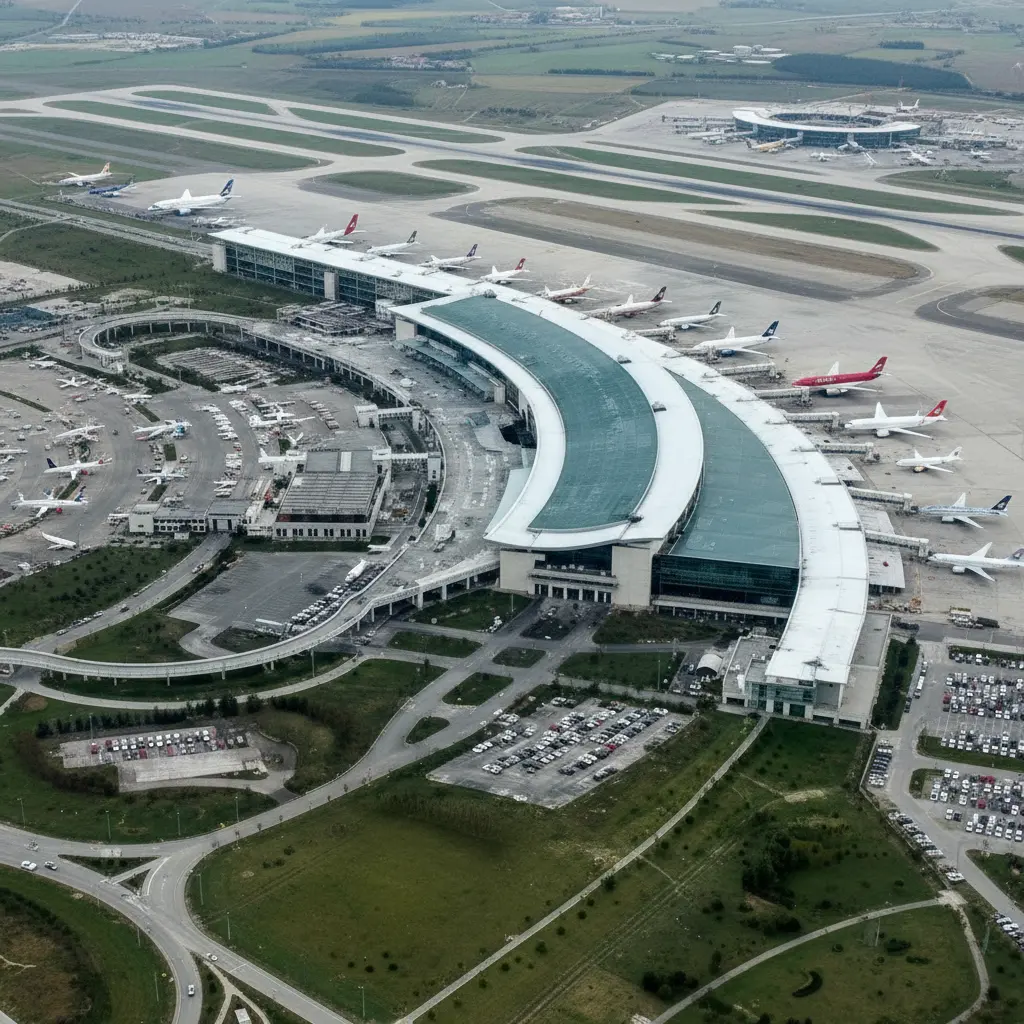
Ankara Esenboğa Airport, Uraloğlu affirmed, will be a modern, safe, and high-capacity global aviation hub befitting the capital and the country, capable of meeting current and future needs. “Our airport’s annual passenger capacity is increasing from 20 million to 30 million, allowing our capital to gain even more altitude,” he reiterated.
The second phase of the project will involve the expansion of the Terminal Building by at least 40,000 square meters, along with general aviation apron and taxiway works. Notably, this project, requiring an investment of 298 million euros, was realized without any public funds. Furthermore, without any passenger guarantees, the project is expected to generate 560 million euros in rental income, including VAT, over a 25-year operating period.
Public-Private Partnership Success
Uraloğlu highlighted the success of Public-Private Partnership (PPP) models in aviation projects. “The approximate surplus fee collected from PPP projects like Istanbul Airport and Çukurova International Airport since their inception is around 360 million euros. The total rent, facility, and land use fees collected from all PPP airports amount to approximately 9.6 billion euros. With this model, we have contributed approximately 10 billion euros to our country’s economy.”
He emphasized that the rental and usage fees obtained from PPP airports constitute the main revenue stream of the model, representing a financial success. “This is concrete evidence of our win-win approach, which encourages both the effective use of public resources and private sector investments,” Uraloğlu concluded.
The inaugurated facilities are not just structures of stone and steel but symbols of the capital’s rise. The resurgence of Ankara Esenboğa Airport with its new facade is a source of pride not only for the capital but for the entire country.
Source: https://www.trthaber.com/haber/turkiye/ankara-esenboga-havalimaninin-kapasitesi-artiyor-931811.html