
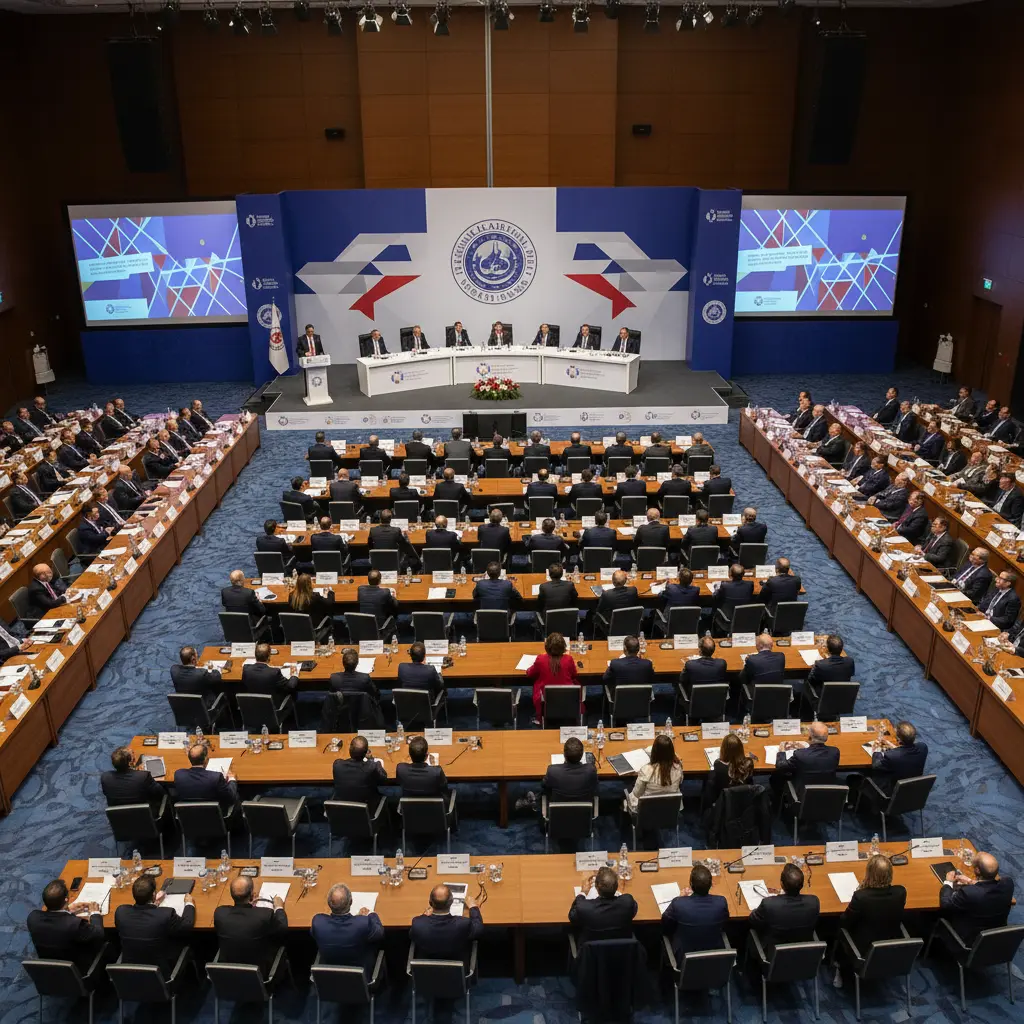
Ankara, April 6 – The inaugural International Halal Accreditation Congress convened today in Ankara, bringing together public representatives, academics, industry stakeholders, experts, and ambassadors from various countries. The congress commenced with a recitation from the Quran, highlighting the significance of the halal concept in economic activities.
Halal Sector Projected to Reach $3.5 Trillion by 2028
Trade Minister Ömer Bolat, in his opening speech, emphasized the growing importance of the halal sector. He noted that the sector, valued at $2.3 trillion in 2024 and $2.5 trillion last year, is projected to expand to $3.5 trillion by 2028. Bolat attributed this growth to demographic shifts, economic transformation, and technological advancements, which are collectively increasing the global demand for halal products and services.
“By 2030, we will have over 540 million Muslim youth. Population growth, economic and demographic transformation, technological developments will increase the global demand for halal products and services,” Bolat stated.
Turkey’s Trade with Islamic Countries Exceeds 26%
Bolat underscored the importance of the Organization of Islamic Cooperation (OIC) for Turkey, reiterating the government’s commitment to developing trade with Islamic countries. He highlighted that the share of the Islamic world in Turkey’s foreign trade, which was 11% in 2002, surpassed 26% last year. The minister set a target of exceeding 30% by 2030.
“Our total foreign trade with the Islamic world will be 115 billion dollars by 2025. The concept of halal is very important in terms of Islamic obligation, trust, health, and especially being consumer-friendly. The population of Muslim communities in the world has exceeded 2 billion, constituting 25% of the global population,” Bolat added.
Halal Accreditation Agency’s Significant Contributions
The Halal Accreditation Agency (HAK), established to address the need for regulation and supervision in the halal sector, has undertaken significant work. Bolat mentioned that HAK has received 227 applications from 35 countries and has granted accreditation certificates to 132 organizations seeking halal certification. Currently, over 2,500 halal-certified production facilities are under the assurance of HAK’s accreditation. Furthermore, HAK has provided training on halal accreditation to more than 1,600 guest participants from 35 countries in Turkey.
Challenges and Future of Halal Accreditation
Zafer Soylu, President of HAK, acknowledged that the rapid growth of the halal sector presents certain structural challenges. He pointed out that varying certification systems across different countries can lead to increased costs and time loss for producers, and create trust issues for consumers. Soylu emphasized that halal accreditation is a fundamental element in ensuring the reliability and integrity of the system.
Soylu stressed the necessity of establishing a standardized structure, incorporating both technical and jurisprudential aspects, with the contributions of OIC member countries. He also called for the creation of an international body comprising all halal accreditation agencies to conduct peer evaluations, thereby eliminating redundant certifications and fostering trust.
Other Speakers Emphasize Halal’s Broader Impact
Abdurrahman Haçkalı, President of the Religious Affairs High Council of the Presidency of Religious Affairs, stated that the halal certification process not only preserves religious sensitivities but also contributes to the common good of humanity.
Abdullah Eren, President of the Turkish Cooperation and Coordination Agency (TİKA), highlighted the need to create alternatives in development efforts, including halal accreditation, in today’s world. He noted that under the leadership of President Recep Tayyip Erdoğan, Turkey has extended its hand to many different regions of the world over the past 23 years.
Following the speeches, Minister Bolat was presented with a gift to commemorate the occasion.