


In the past month, Turkey’s Ministry of Transport and Infrastructure has unveiled details on two significant railway projects: the long-awaited Ankara-Izmir High-Speed Train (YHT) and the Northern Railway Crossing, designed to link Istanbul’s two airports. These initiatives, with a combined length of 746 kilometers and an estimated total cost of $9.09 billion, represent a substantial investment in the nation’s infrastructure. However, a closer look reveals a complex web of delays, financial intricacies, and strategic considerations that warrant a deeper analysis.
Ankara-Izmir YHT: A Decade of Delays and Shifting Timelines
The Ankara-Izmir YHT project, initially announced in 2013 with a promise of completion in three years, has become a symbol of protracted infrastructure development. The Ministry of Transport and Infrastructure recently declared that the 624-kilometer line, which will reduce travel time between Ankara and Izmir from 14 hours by rail to a mere 3.5 hours, is expected to reach Afyonkarahisar by the end of this year and be fully operational by the end of 2027. This revised timeline, however, comes after a decade of missed deadlines and substantial cost revisions.
The project, which traverses seven provinces including Ankara, Eskişehir, Afyonkarahisar, Kütahya, Uşak, Manisa, and Izmir, commenced construction in 2012. Multiple contractors were initially involved in the infrastructure works, but in 2018, these were suspended. By 2020, ERG Joint Venture (comprising ERG International UK Ltd., ERG İnşaat Ticaret ve Sanayi A.Ş., and SSB Sauerwein & Schaefer Bau AG) secured the main contract for superstructure, electrification, signaling, and building works, valued at 2.16 billion euros.
The Ministry has attributed the delays to “administrative obstacles,” with Minister Abdulkadir Uraloğlu stating in August 2025 that these hurdles had been “completely removed.” ERG İnşaat, in a statement on December 22, 2025, further elaborated, citing a multitude of factors including “route and project revisions, challenging geological and ground conditions, financing structures, international technical standards, the pandemic, global supply chain issues, and changing public priorities post-earthquake.” They emphasized that “work never stopped at any stage” and that “actual manufacturing continued on site.”
However, sources from the United Transport Workers’ Union suggest that “problems in ground surveys led to repeated revisions in the project, resulting in cost increases and contractor changes, causing an unusual delay, with the pandemic further slowing the process.” This perspective highlights the technical complexities and managerial challenges that have plagued the project.
Economic Lifeline for British Steel
The Ankara-Izmir YHT project, despite its delays, has had an unexpected international economic impact. In 2022, the UK Export Finance, guaranteed by the UK government, provided a 1.7 billion sterling (approximately $2.3 billion at the time) loan through Credit Suisse and Standard Chartered Bank. This was hailed as the UK government’s largest sustainable civil infrastructure agreement.
Significantly, on February 18, 2026, ERG International Group announced an agreement with British Steel for the supply of 36,000 tons of rails. This deal has been a lifeline for the British industrial giant, which faced bankruptcy in May 2019 and continued to struggle even after its acquisition by China’s Jingye Group in March 2020. The agreement has created 23 new skilled manufacturing positions at British Steel and expanded the rail production capacity at its Scunthorpe facility, which was at risk of closure just months prior. This demonstrates how large-scale infrastructure projects can have far-reaching economic benefits beyond national borders.
Ankara-Izmir YHT Project Sections:
| Section | Region | Length (km) | Infrastructure | Superstructure |
|---|---|---|---|---|
| Section 1 | Polatlı-Afyon | 151.2 | ERG | ERG |
| Section 2a | Afyon-Hatipler | 78.8 | ERG | ERG |
| Section 2b | Hatipler Geçidi | 11.5 | ERG | ERG |
| Section 3a | Banaz-Esme | 85.6 | AGA Energy | ERG |
| Section 3b | Esme-Salihli | 74.3 | Bayburt Grup+Kolin | ERG |
| Section 4a | Salihli-Manisa | 17.5 | NAS+Budakyol | ERG |
| Section 4b | Salihli-Manisa | 44.5 | ERG | ERG |
| Section 4c | Manisa Kuzey | 14.0 | ERG | ERG |
| Section 4d | Manisa-Menemen | 25.8 | AGA Energy | ERG |
Northern Railway Crossing: Connecting Istanbul’s Airports
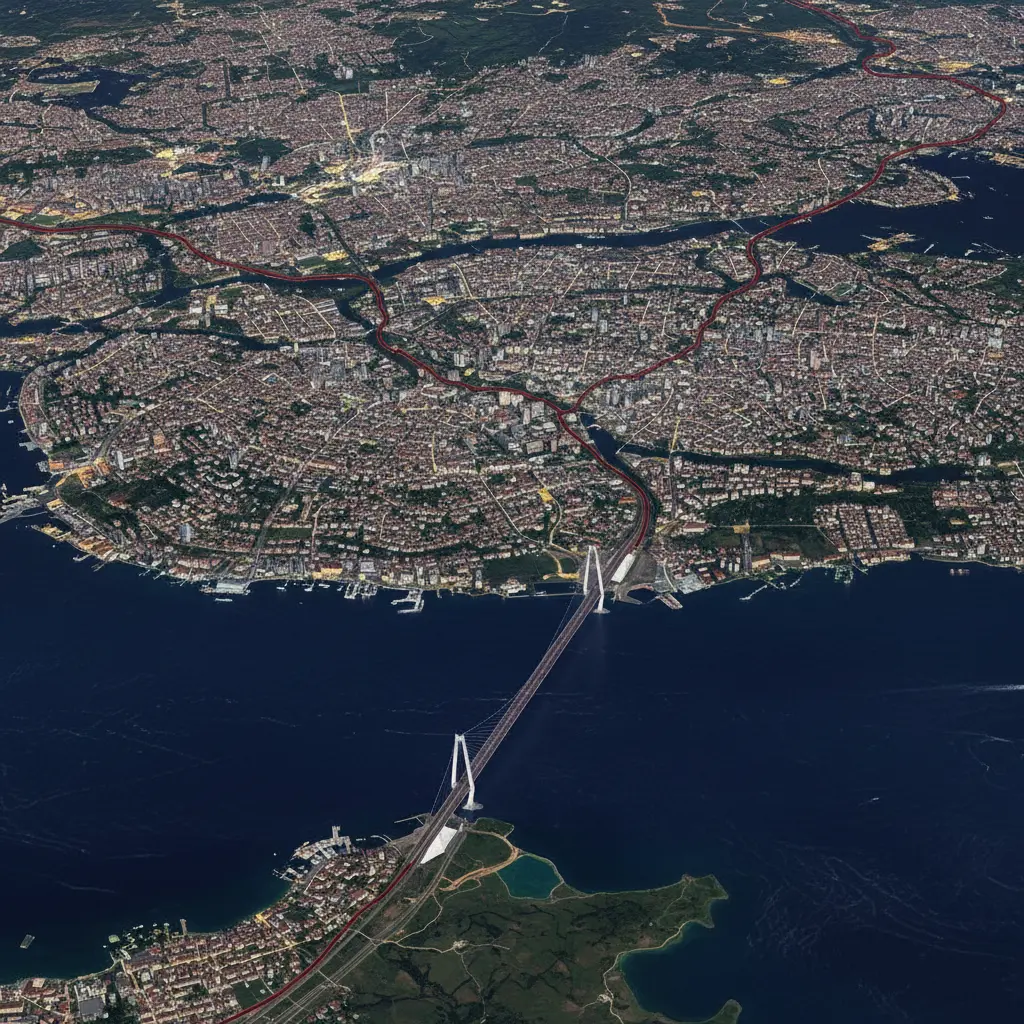
The second major undertaking, the Northern Railway Crossing, aims to connect Istanbul’s two airports. An tender announcement was published in the Official Gazette on February 27, outlining the construction of a 122.3 km high-speed railway infrastructure with a maximum speed of 160 km/h, linking Çayırova and Çatalca.
This project will begin at the Çayırova section of the Marmaray line, turn north after Sabiha Gökçen Airport, cross the Bosphorus via the 59-meter-wide Yavuz Sultan Selim Bridge (which has a pre-determined area for railway use with four lanes in each direction), reach Istanbul Airport, and then integrate with the ongoing Halkalı-Kapıkule High-Speed Train Line in Çatalca.
The primary objectives of this line are to alleviate freight and passenger traffic on the Marmaray line and to directly connect Istanbul Airport and Sabiha Gökçen Airport by rail for the first time. The project includes the construction of 44 tunnels spanning 59.1 kilometers and 42 bridges totaling 22.4 kilometers. Minister Uraloğlu announced that tender preparations are underway, with the process expected to be completed and site delivery made within this year. Upon completion, the line is projected to transport 33 million passengers and 30 million tons of freight annually.
Financial Backing and Implementation Strategy
The Northern Railway Crossing, with a total financing amount of $6.75 billion, is supported by a consortium of six international financial institutions: the Asian Infrastructure Investment Bank, Asian Development Bank, European Bank for Reconstruction and Development, Islamic Development Bank, and OPEC Fund for International Development. The project is planned to be completed in four sections, with three private tenders for consultancy services planned for March and five for construction works in April.
Tender Package Details:
| Category | Estimated Publication Date |
|---|---|
| Section 1: 28.49 km (Construction) | April 2026 |
| Section 2: 25.76 km (Construction) | April 2026 |
| Section 3: 32.15 km (Construction) | April 2026 |
| Section 4: 39.49 km (Construction) | April 2026 |
| Signaling and Telecommunications (Construction) | April 2026 |
| Construction Works Consultancy | March 2026 |
| Project Management Consultant | March 2026 |
| Project Implementation Supervision Consultant | March 2026 |
According to the Environmental and Social Impact Report prepared for the project, the Sabiha Gökçen Airport Station will feature direct integration with the INRAIL line, passing under the terminal, and additional arrangements for freight operations. For Istanbul Airport Station, Alternative 2 has been selected, proposing separate railway lines and dedicated stations for freight and passenger services. This option offers significant operational safety advantages, particularly considering the potential risks associated with transporting hazardous materials by freight trains. Furthermore, a direct railway connection to the cargo terminal at Istanbul Airport is planned, which is expected to enhance efficiency, reduce reliance on road transport, and decrease associated emissions by enabling seamless transfers between air and rail freight systems.
The Broader Implications: A Test of Strategic Planning
These two ambitious railway projects underscore Turkey’s commitment to modernizing its transport infrastructure. However, the decade-long delays in the Ankara-Izmir YHT project raise critical questions about the efficacy of long-term planning, project management, and the ability to mitigate unforeseen challenges. While the Ministry and contractors cite various external factors, the consistent revisions and cost overruns suggest deeper systemic issues that need to be addressed for future large-scale developments.
The Northern Railway Crossing, with its international financial backing and strategic importance in connecting key transportation hubs, represents a forward-looking approach. Yet, its success will depend on efficient execution and the ability to learn from the challenges encountered in previous projects. The emphasis on environmental and social impact assessments, particularly regarding freight transport and airport integration, indicates a growing awareness of the broader implications of such massive undertakings.
Ultimately, these projects are more than just railway lines; they are indicators of Turkey’s capacity for strategic development, its resilience in overcoming obstacles, and its commitment to integrating into global economic networks. As the country navigates complex geopolitical and economic landscapes, the successful completion and operational efficiency of these rail networks will be a significant testament to its progress and a critical factor in its future economic trajectory.