
In the past month, Turkey’s Ministry of Transport and Infrastructure has made two significant announcements regarding railway projects. First, the public was informed that the Ankara-Izmir high-speed train project, which began construction in 2013, is expected to be completed by the end of 2027. Second, details emerged about a new railway line in Istanbul that will connect its two airports. Let’s delve into the specifics of these two ambitious undertakings.
Ankara-Izmir High-Speed Train: A Decade of Delays and Rising Costs
The Ankara-Izmir High-Speed Train (YHT) project aims to reduce the 824-kilometer journey between Ankara and Izmir to 624 kilometers, cutting travel time from 7 hours by road and 14 hours by conventional rail to a mere 3.5 hours. The Ministry of Transport and Infrastructure announced that the line would reach Afyonkarahisar by the end of this year and be fully operational to Izmir by the end of 2027.
However, this project was initially expected to be operational in 2016, with an initial completion timeline of “1,080 days, or three years,” announced in 2013. A decade later, the project remains unfinished. What caused this prolonged delay, and what does it reveal about large-scale infrastructure planning in Turkey?
The Labyrinth of Construction and Financial Revisions
Construction work on the 503-kilometer line, spanning Ankara, Eskişehir, Afyonkarahisar, Kütahya, Uşak, Manisa, and Izmir, began in 2012 under the tenure of Binali Yıldırım as Minister of Transport and Infrastructure. The project was divided into four sections, with multiple contractors responsible for the infrastructure. In 2018, infrastructure work was suspended. By 2020, the main contractor for superstructure, electrification, signaling, buildings, and facilities became ERG Joint Venture (ERG International UK Ltd., ERG İnşaat Ticaret ve Sanayi A.Ş., and SSB Sauerwein & Schaefer Bau AG) with a contract value of 2.16 billion euros. Construction continued in sections previously contracted by TCDD from the second quarter of 2021.
The ministry has offered vague explanations for the delays, with Minister Abdulkadir Uraloğlu stating after a site visit in August 2025 that “problems were encountered from time to time, but administrative and other obstacles have been completely removed.” ERG İnşaat, however, provided a more detailed response on December 22, 2025, attributing the delays to a confluence of factors:
- Route and project revisions
- Challenging geological and ground conditions
- Financing structures
- International technical standards
- The pandemic, global supply chain issues, and changing public priorities post-earthquake
The company emphasized that “work never stopped at any stage, actual manufacturing continued on site, projects were updated in line with technical requirements, and the efficient, effective, and permanent use of public resources was prioritized.”
However, sources from the United Transportation Employees Union suggest that “problems in ground surveys led to numerous project revisions, resulting in increased costs and contractor changes, causing an abnormal delay, with the pandemic further slowing the process.”
Financial Lifelines and International Partnerships
The project, now aimed for completion in 2027, will feature over 1,200 structures, including 49 tunnels and 779 bridges. It is expected to transport 13.3 million passengers and 90 million tons of freight annually. The initial project cost, announced as 4.3 billion TL in 2013 (approximately $2.26 billion at the time), has been revised multiple times, with the latest estimate in 2026 reaching 101 billion 487 million 60 thousand TL, or approximately $2.34 billion.
A significant financial boost came in 2022 when the UK Export Finance, guaranteed by the UK government, provided a 1.7 billion sterling (approximately $2.3 billion at the time) loan through Credit Suisse and Standard Chartered Bank. This was hailed as the “largest sustainable civil infrastructure deal ever for the UK government,” aiming to decarbonize travel in Turkey and award major contracts to both British and Turkish companies.
Indeed, the project has had a tangible economic impact beyond Turkey. According to an announcement by ERG International Group on February 18, 2026, the Ankara-Izmir YHT project has provided a lifeline to the British industrial giant British Steel. ERG will procure 36,000 tons of rail from British Steel this year. This agreement has created 23 new skilled manufacturing positions at British Steel and expanded rail production capacity at its Scunthorpe facility, which faced closure risks just months prior.
Northern Railway Pass: Connecting Istanbul’s Aviation Hubs
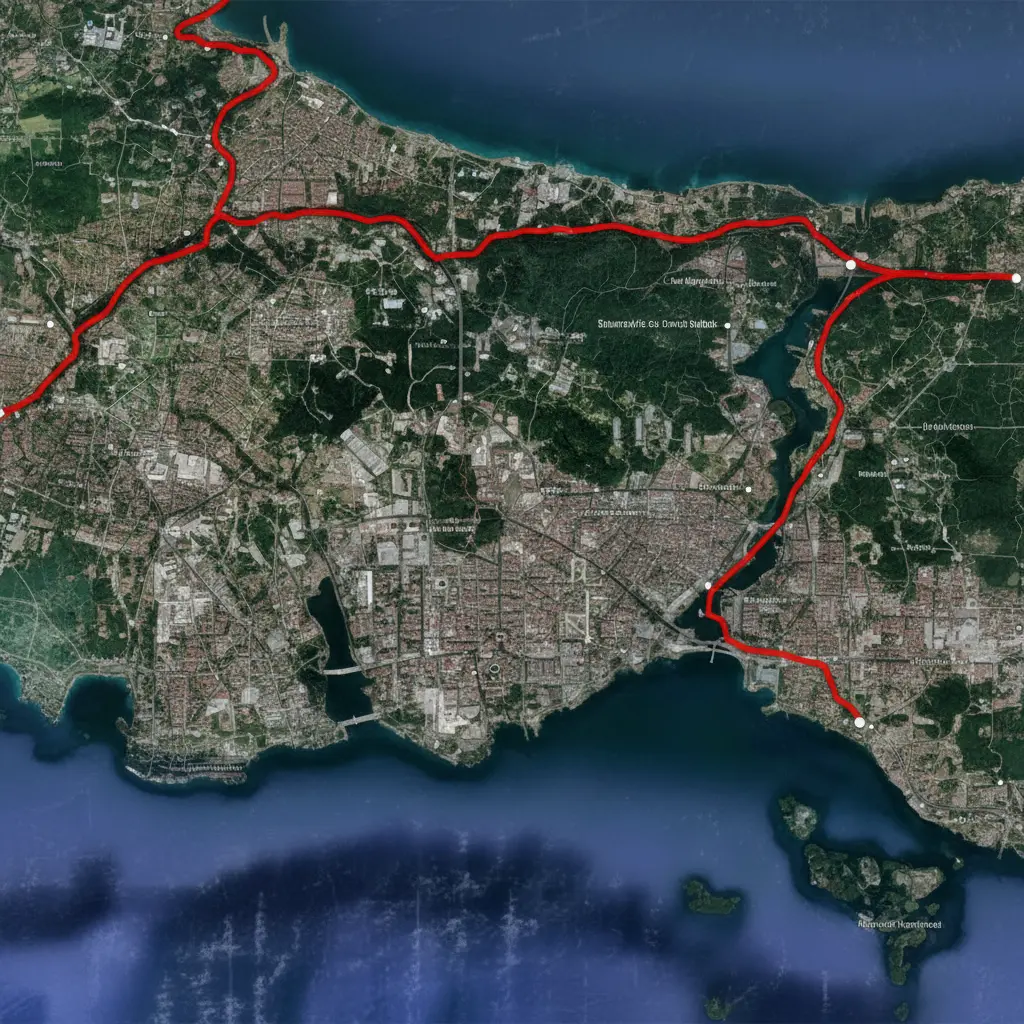
The second major project, the Northern Railway Pass, aims to connect Istanbul’s two airports. An tender announcement was published in the Official Gazette on February 27, detailing the construction of a 122.3 km high-speed railway infrastructure with a maximum speed of 160 km/h, connecting Çayırova and Çatalca.
The line will start from the Çayırova section of the Marmaray line, turn north after Sabiha Gökçen Airport, cross the Bosphorus via the 59-meter wide Yavuz Sultan Selim Bridge (which has a dedicated rail section), reach Istanbul Airport, and then integrate with the ongoing Halkalı-Kapıkule High-Speed Train Line in Çatalca.
Relieving Congestion and Boosting Connectivity
This project is expected to alleviate congestion on the Marmaray line for both freight and passenger transport, and for the first time, directly connect Istanbul Airport and Sabiha Gökçen Airport by rail. The project includes the construction of 44 tunnels totaling 59.1 kilometers and 42 bridges spanning 22.4 kilometers. Minister Uraloğlu stated that tender preparations are underway, with the process expected to be completed and the site handed over within this year. Upon completion, the line is projected to transport 33 million passengers and 30 million tons of freight annually.
International Financing and Strategic Planning
The project boasts a total financing of $6.75 billion, supported by a consortium of six international financial institutions: the Asian Infrastructure Investment Bank, the Asian Development Bank, the European Bank for Reconstruction and Development, the Islamic Development Bank, and the OPEC Fund for International Development. The project is planned to be completed in four sections, with three special tenders for consultancy services planned for March and five for construction work in April.
According to the Environmental and Social Impact Report prepared for the project, the Sabiha Gökçen Airport Station will feature direct integration of the INRAIL line with the airport complex, including arrangements for freight operations by passing the railway under the terminal. For Istanbul Airport Station, Alternative 2, which proposes separate railway lines and dedicated stations for freight and passenger services, has been selected. This option offers significant operational safety advantages, especially considering the potential risks associated with transporting hazardous materials by freight trains.
Furthermore, a direct railway connection to the cargo terminal at Istanbul Airport is planned. The environmental and social impact analysis highlights that this will enhance efficiency by enabling seamless transfers between air and rail freight systems, reduce reliance on road transport, and decrease associated emissions.
Turkey’s Infrastructure Vision: A Path Fraught with Challenges?
These two ambitious railway projects underscore Turkey’s commitment to modernizing its transportation infrastructure and enhancing connectivity. The Ankara-Izmir YHT, despite its protracted delays and escalating costs, promises significant reductions in travel time and a boost to regional economies. The Northern Railway Pass, meanwhile, aims to streamline travel between Istanbul’s key aviation hubs and improve freight logistics.
However, the history of the Ankara-Izmir project serves as a cautionary tale. The “abnormal delays” and repeated revisions highlight the complexities inherent in large-scale infrastructure development, particularly when confronted with geological challenges, financing hurdles, and unforeseen global events. While international partnerships and financing are crucial, effective project management, transparent communication, and robust contingency planning are equally vital to ensure these investments deliver their promised benefits.
The success of these projects will not only be measured by their completion but also by their ability to integrate seamlessly into existing networks, provide efficient and reliable services, and contribute to Turkey’s broader economic and social development. As the tender processes unfold and construction progresses, the eyes of both domestic and international observers will be on Turkey, watching to see if these ambitious plans can overcome their inherent challenges and truly transform the nation’s transportation landscape.