


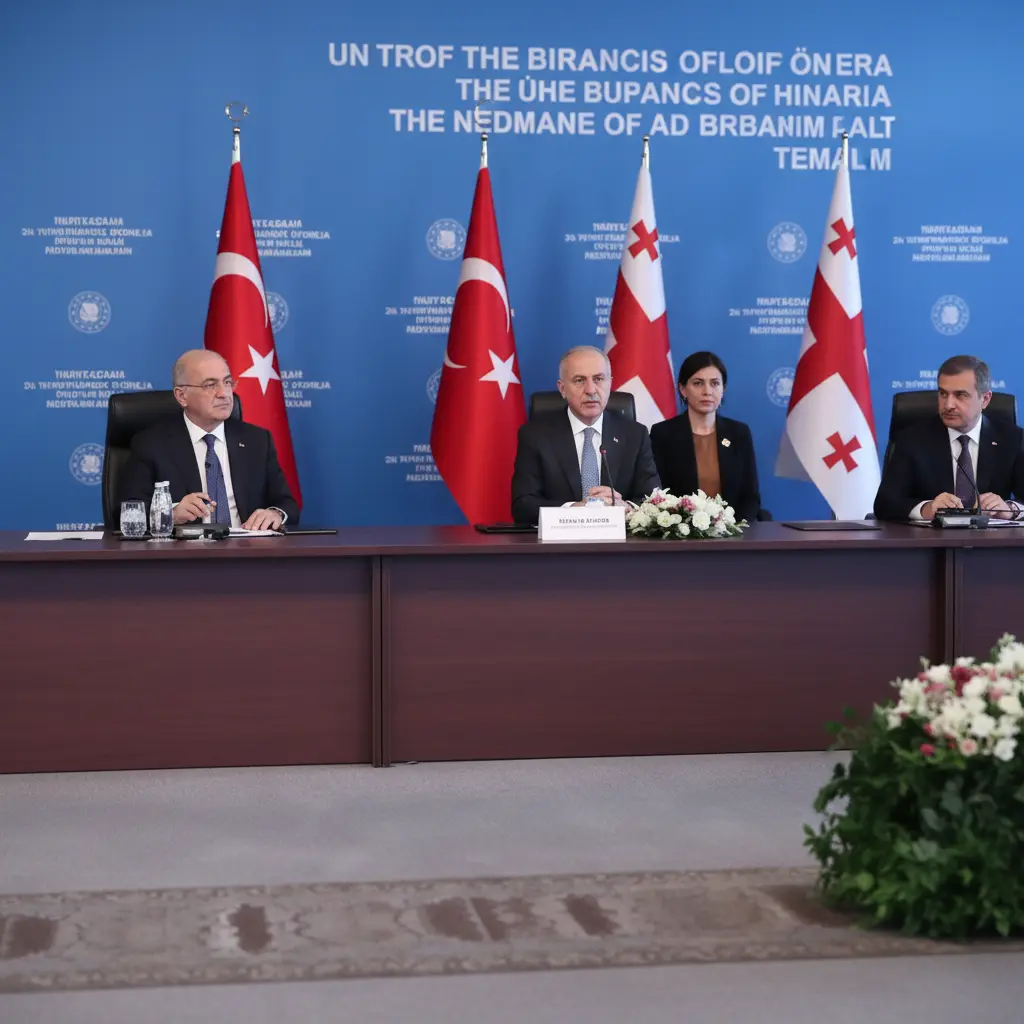
ISTANBUL, June 8, 2026 – Turkish Foreign Minister Hakan Fidan hosted the 10th Trilateral Foreign Ministers Meeting of Turkey, Azerbaijan, and Georgia in Istanbul, where he called for a swift peace agreement between Armenia and Azerbaijan. The meeting, attended by Azerbaijani Foreign Minister Jeyhun Bayramov and Georgian Deputy Prime Minister and Foreign Minister Maka Botchorishvili, focused on critical regional issues.
Key Topics Discussed at the Trilateral Meeting
The agenda for the discussions included “Regional Developments, Foreign Policy Issues, and Cooperation in the South Caucasus,” “Strengthening Transport, Connectivity, and Regional Transit Networks,” and “Deepening Energy Security, Trade, and Economic Cooperation.”
In his address, Minister Fidan underscored the significance of the trilateral mechanism, stating, “This tenth meeting of the trilateral mechanism, which we established with a sense of regional ownership, has once again demonstrated that it has become a productive consultation platform that builds trust in our region. This mechanism, which has been operating continuously for nearly 14 years, has provided many benefits to our countries over the years.”
Fidan highlighted that this platform has facilitated strategic steps across a broad spectrum, from strengthening political dialogue to economic integration, transport, energy security, trade, and humanitarian ties. He added, “The meaning we attach to this cooperation is not limited to the common interests of the three countries. We also see this mechanism as one of the guarantors of peace, stability, and sustainable prosperity in the South Caucasus.”
Call for Armenia-Azerbaijan Peace Agreement
Minister Fidan emphasized the importance of the peace process between Azerbaijan and Armenia, stating, “We desire and work towards a region that is associated with development projects instead of conflicts, and with common prosperity and connectivity projects instead of polarization. The most promising manifestation of this vision today is the peace process between Azerbaijan and Armenia. The will demonstrated by the parties has opened a concrete window of opportunity for our region.”
He further added, “We support the peace process between Azerbaijan and Armenia. We also hope that Azerbaijan’s legitimate concerns will be addressed, and a peace agreement will be signed without delay. The normalization process we are conducting with Armenia continues in close coordination with Azerbaijan.”
Regional Stability and Connectivity
Fidan pointed out that the world is experiencing one of those rare periods where geopolitical ruptures are occurring simultaneously, with increasing economic uncertainties and energy security becoming a more sensitive issue than ever before. He stated, “In such a period, the atmosphere of peace and cooperation we have established in our region expresses a true strategic value. This environment contributes to stability, connectivity, energy supply security, and national economies across a vast geography extending from Europe to Asia. Strengthening the connections between our countries, in particular, will contribute to regional stability. It stands out as a strategic and geopolitical priority.”
Energy, in this context, holds particular importance. Fidan noted, “Access to energy at a reasonable cost and without interruption has become a vital issue for the entire world today. Thanks to the energy infrastructure projects we have implemented together, the impact of crises in this area has remained minimal for us. We have made our region more resilient against global energy fluctuations. Our next goal is to build an even more integrated region in energy, transport, and communication infrastructures.”
He stressed that this integration is also strategically important for creating a safer, faster, and more predictable transit route between Europe and Asia. The most concrete point reached by this goal today is the strengthening role of the Middle Corridor.
Middle Corridor and Baku-Tbilisi-Kars Railway
Fidan underlined that the Middle Corridor has become one of the strategic backbones of strong cooperation. In this regard, he cited the ceremony held on June 2 in the Georgian section of the Baku-Tbilisi-Kars railway line, marking an important milestone as the line reached its full capacity.
The aim is to maximize the benefits from this strategic line to provide more added value to the region. Fidan also reiterated the common understanding that stability, peace, and prosperity in the South Caucasus should be shaped on the basis of sincere and constructive cooperation.
Ongoing Conflicts and Regional Risks
Despite the positive outlook for peace in the South Caucasus, Fidan noted that the surrounding security environment continues to pose serious risks. In this context, the meeting addressed the peace talks between Iran and the United States.
Fidan emphasized the urgency of leaving behind a war that has brought the region and the world to the brink of disaster. He explained that contacts with the US and Iran are being maintained, and close consultations with regional countries are underway to achieve lasting peace. Turkey, he stated, will continue to support diplomacy and dialogue during this critical period.
Regarding the ongoing war in the north, he said, “The ongoing war in our north directly affects the security of our region. We consider achieving peace in the Russia-Ukraine war essential for the stability and security of our region. We believe that this diplomatic process and peace efforts must be continued with determination. We are all following the current stalemate in the battlefield and the diplomatic process with concern. The steps taken by the parties to turn this stalemate in their favor, unfortunately, further increase the tension on the ground.”
Fidan cited recent attacks in the Black Sea and Sea of Azov as painful examples of how serious the consequences of this danger can be. He extended his condolences to Azerbaijan for those who lost their lives in the recent incident.
“Today, as three countries, we reaffirmed our common will for the future of our region, mutual trust, and the shared vision we have built together. The stronger the cooperation between our countries, the safer, more prosperous, and more stable the South Caucasus will become,” Fidan concluded.
Black Sea Security and Diplomacy
Answering questions from the press regarding the Russia-Ukraine War, the tension in the Black and Baltic Seas, and attacks on some ships, Fidan stated, “The unfortunate events mentioned in the question repeatedly demonstrate how accurate our President (Recep Tayyip Erdoğan)’s sensitivity regarding a ceasefire in the Russia-Ukraine War has been from the very beginning.”
Fidan pointed out that the war is tending to spread geographically, with weapons and ammunition used by the warring parties now seen in the Baltic countries of Estonia, Lithuania, and Latvia, and Romania being affected. He noted that mines and unmanned marine vehicles can drift as far as the Turkish straits, and Georgia can also be targeted.
“PARTIES ARE LOOKING FOR MORE DIFFERENT TARGETS TO STRIKE”
Fidan stated that all these developments show how geographical spread occurs as the war continues. “Now, the parties are increasingly looking for different targets to strike to change the existing military equation. There are almost no limits left regarding any target, infrastructure, or superstructure. This shows the destructive effect of the war.”
He recalled that in the past, formulas were created for parties to be careful about certain issues while this destructive war continued, and Turkey brought the Black Sea Grain Initiative to the agenda, with President Erdoğan playing an important role in this regard.
“DECREASING NAVIGATION SAFETY IN THE BLACK SEA IS CONCERNING”
Fidan stated that this initiative was implemented for a while and was a historical success. “Similarly, the decreasing navigation safety in the Black Sea due to the spread of the war is worrying for all of us.”
He emphasized that they are collectively following the issue very closely and are constantly in contact with the parties, highlighting the importance of not targeting Turkish and other civilian ships. Fidan also noted that misunderstandings in target classification and identification due to out-of-control unmanned aerial vehicles and missiles in the combat zone can lead to such tragedies.
Fidan stressed the extreme importance of fishing boats and cargo ships navigating in territorial waters in coordination with relevant institutions, emphasizing the close solidarity and coordination in this matter. He underlined that the government and the ministry are following the issue very closely, adding, “But solving the problem fundamentally will be the biggest answer to all problems. That’s why we attach great importance to ceasefire talks.”
Fidan stated that Turkey attaches importance to regional ownership and regional cooperation for ensuring stability and development, which is one of the main parameters of President Erdoğan’s regional policy from the beginning.
SOUTH CAUCASUS PARTNERSHIP SHOULD ALSO BE APPLIED TO THE BALKANS AND THE MIDDLE EAST
Fidan said that Turkey should apply the same vision it has put forward with this trilateral partnership in the South Caucasus for stability and peace with partners in the Balkans and the Middle East.
Minister Fidan noted that Turkey’s aim is to establish regional cooperation and peace in all strategic basins it is located in, to prevent or reduce the severity of conflicts, and to create an environment that will easily open the way for development, prosperity, freedom, and human rights.
He stated that for this, they must be strong, deterrent, effective, and work hard. “We believe that the instability created by the effects of non-regional actors in the South Caucasus for many years should turn into stability through the hands of regional actors, and that other regional peoples should support this stability through international cooperation.”
Fidan stated that Turkey, Georgia, and Azerbaijan are trying to continue their path with a model of regional ownership and cooperation by presenting an exemplary cooperation model, and thanked his two counterparts for this.
Source: http://mobil.hurriyet.com.tr/dunya/turkiye-azerbaycan-gurcistan-uclu-disisleri-bakanlari-toplantisi-istanbulda-basladi-43197856