


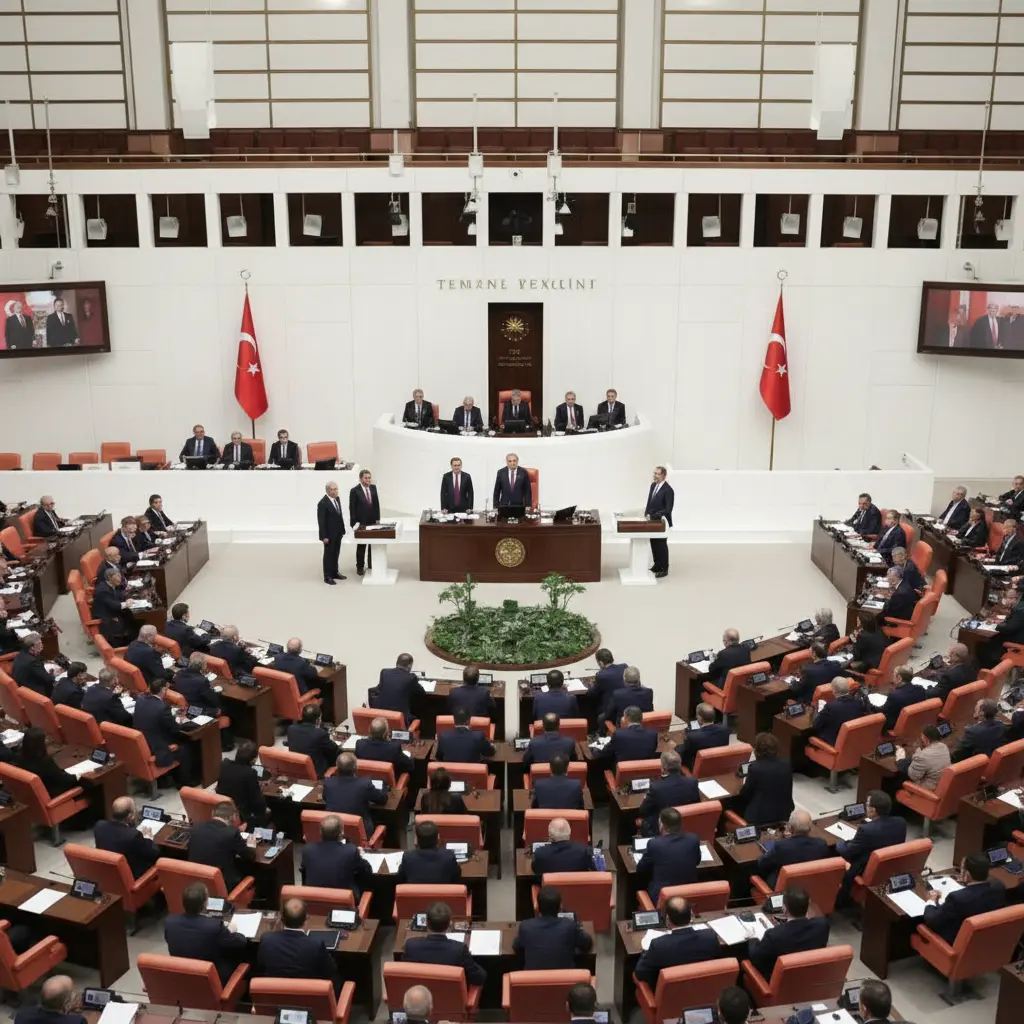
Turkish Parliament Passes Comprehensive Bill on Site Fees, Urban Transformation, and Environmental Regulations
Ankara, May 8, 2026 – The Turkish Grand National Assembly (TBMM) has approved a comprehensive bill titled ‘Law on Amendments to the Land Registry Law and Certain Laws and Decree Law No. 375,’ which includes significant regulations concerning exorbitant site fees, urban transformation, and environmental protection. The bill was accepted during a General Assembly meeting chaired by Deputy Speaker Tekin Bingöl.
Measures to Curb Arbitrary Site Fees
A key aspect of the newly accepted law is the amendment to the Condominium Law, designed to prevent building managers from unilaterally imposing excessive site fees. Under the new provisions, the operating plan and the amount of advance payments to be collected will now require approval from the board of homeowners. If an existing operating plan is not in place, the manager must prepare a provisional plan within three months. The proposed increase rate in this provisional plan cannot exceed the revaluation rate of the previous year. Provisional plans must be communicated to homeowners via signed receipt or registered mail and finalized at the General Assembly within three months.
Furthermore, amendments to the ‘management plan and its modification’ article stipulate that a two-thirds majority vote of the independent sections represented by the collective building representatives is required to change the management plan. Provisions of the management plan regarding temporary management can be altered with a two-thirds majority vote of the independent section owners in the collective building area. Any provisions in management plans that contradict this article will not be enforced.
Urban Transformation and Planned Development
The law also aims to transform cities into more planned and healthy areas by facilitating the use of idle properties for urban transformation projects, social housing initiatives, and the creation of new living spaces with various social and cultural facilities. Local administrations, their affiliated organizations, local administration unions, and companies established by them, as well as those directly or indirectly affiliated, will require presidential approval to establish new companies or cooperatives, participate in capital, or acquire shares through gratuitous transfers.
In transfers between the Treasury’s private properties and properties belonging to ministries, affiliated, related, and associated institutions and organizations, the properties will be registered ex officio based on the letter from the owning administration. Forty percent of the income generated from property evaluations will be transferred to the evaluating administration, while sixty percent will be used by the evaluating administration, institution, or organization, and their enterprises, affiliates, and subsidiaries.
Regulations for Construction Sector Professionals
The ‘Law on Building Inspection’ has been amended to redefine ‘Laboratory’ and introduce new definitions for ‘Concrete producer’ and ‘Soil and foundation survey organization.’ At least one partner in a soil and foundation survey organization must be a geology, geophysics, or civil engineer. Building inspection, soil and foundation survey, and laboratory organizations will be required to provide collateral.
Partners of building inspection organizations that receive a ban on new work will be prohibited from technical duties during the penalty period, while partners of those receiving a permanent ban will be barred for three years from technical duties and from being a partner in another building inspection or laboratory organization. Similarly, partners of laboratories receiving a ban on new work will face restrictions during the penalty period, and those with a permanent ban will be prohibited for three years from technical duties and from being a partner in any building inspection, soil and foundation survey, or laboratory organization.
Penalties for Non-Compliance in Concrete Production
The law introduces administrative fines for concrete producers. A fine of 500,000 Turkish Liras will be imposed by the Provincial Directorate of Environment, Urbanization, and Climate Change, upon the proposal of the Provincial Building Inspection Commission, if hardened concrete test results for building inspection fail to meet the relevant standards. Additionally, concrete producers will face a 250,000 Turkish Lira administrative fine if, within the monitoring system managed by the Ministry, poured concrete lacks a mixer label and delivery note, or if the mixer label and QR-coded delivery note do not match.
Amendments to the Mass Housing Law
Changes to the ‘Mass Housing Law’ stipulate that real estate sales contracts and real estate preliminary sales contracts for the transfer of property rights by the Mass Housing Administration (TOKİ) do not require a formal written form. Application documents, negotiation minutes, and other pre-contractual paperwork can be processed electronically or via remote communication tools, with identity verification methods. In cases of death, if legal heirs do not provide a certificate of inheritance, the Administration can apply to a court or notary for the issuance of such a certificate without judicial authorization. The Administration will also be exempt from depositing collateral in lawsuits and enforcement proceedings related to its duties.
Furthermore, in social housing areas designated as new settlement areas, the Ministry of Environment, Urbanization, and Climate Change can decide on the transfer or urgent expropriation of properties belonging to public institutions and organizations, as well as other privately owned properties included in the implementation. Expropriation procedures will be carried out by the Ministry of Environment, Urbanization, and Climate Change or the Mass Housing Administration.
Environmental Protection and Penalties
In line with a Constitutional Court (AYM) annulment decision, the ‘Environmental Law’ has been amended. The definition of ‘Environmental consulting firm’ has been revised, and the term ‘Authorized person’ has been added to the law. An environmental consulting firm is defined as a legal entity authorized by the Ministry of Environment, Urbanization, and Climate Change to prepare reports and technical documents, make applications, and report violations to the Ministry as part of environmental management services. An authorized person is defined as an individual graduated from engineering or science faculties of universities, authorized by the Ministry to provide environmental management services.
The bill also introduces administrative penalties. Those who do not obtain environmental management services, do not establish an environmental management unit, or do not receive services from environmental consulting firms will be fined 209,624 Turkish Liras. Those who do not employ an environmental engineer or an authorized person by the Ministry will face a 139,746 Turkish Lira administrative fine. Institutions, organizations, and businesses whose activities cause environmental pollution or harm the environment will be obliged to obtain environmental management services. Procedures and principles for this will be determined by a regulation issued by the Ministry.
Environmental consulting firms that violate these provisions will be fined 75,000 Turkish Liras. Environmental management service providers who fail to fulfill their obligations, as determined by the relevant regulation, will be subject to penalty points. If 100 penalty points are accumulated within four years, their qualification certificate will be suspended for 180 days. If 200 penalty points are accumulated within four years, the qualification certificate will be revoked for two years. Environmental consulting firms are also obligated to report any violations of environmental legislation by the institutions, organizations, and businesses they serve to the Ministry.
Following the acceptance of the bill, the General Assembly proceeded to discuss international agreements.
Source: DHA