
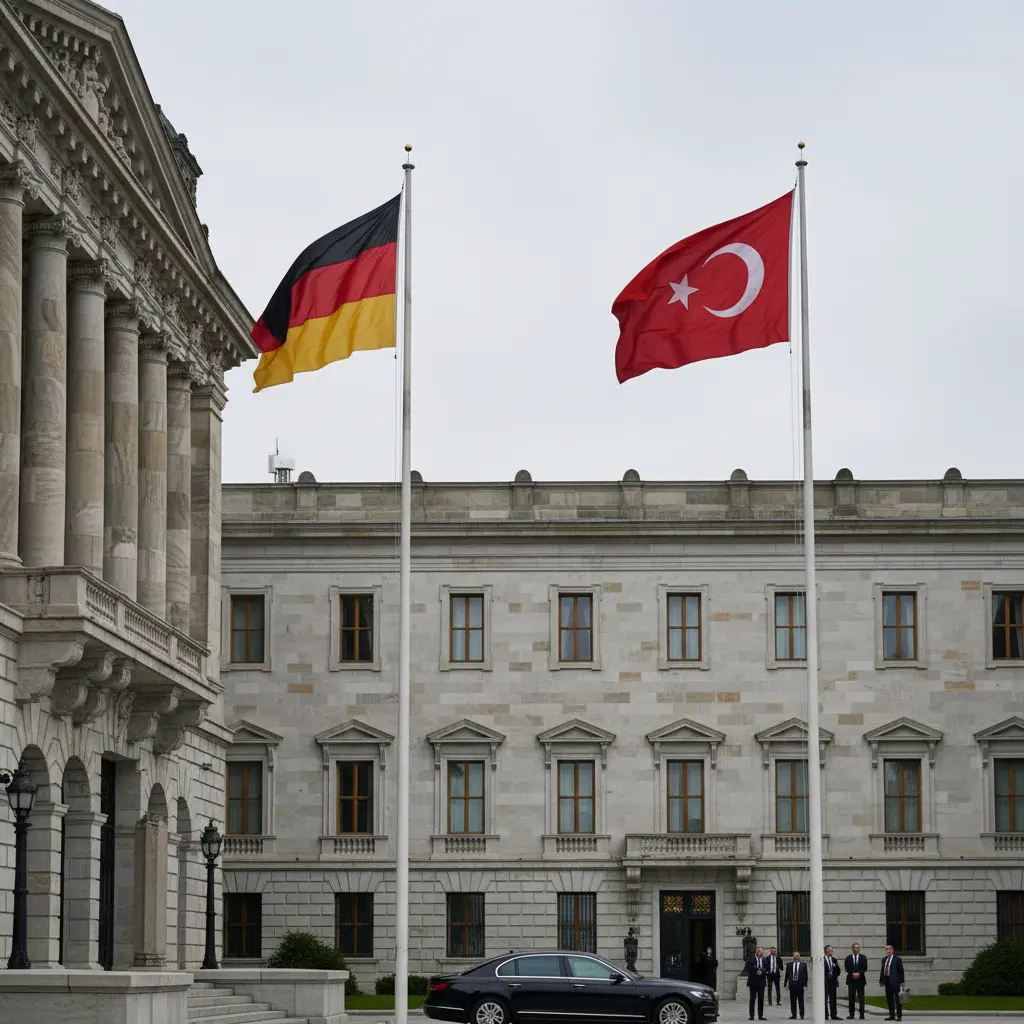
Ankara, June 19 – The 6th Term Turkey-Germany Economic and Trade Joint Committee (JETCO) meeting, along with a round table meeting attended by business representatives from both countries, was held at the Turkish Ministry of Trade. During the meeting, a Turkey-Germany JETCO Protocol was signed by Turkish Trade Minister Ömer Bolat and German Economy and Energy Minister Katherina Reiche, aimed at developing commercial relations between the two nations.
Visa Rejection Rates Decline, Further Facilitation Planned
Minister Bolat stated that visa issues were discussed during their meetings with German Economy and Energy Minister Katherina Reiche. Bolat highlighted a significant improvement, noting, “Visa rejection rates have decreased from 25 percent to 14 percent. At this point, the German side plans to accelerate the process for business people, students, artists, NGO members, and transporters.” He also reiterated Turkey’s “just demands for visa-free travel for Turkish citizens.”
Strengthening Economic Partnership and Investment
Bolat emphasized that the meeting once again demonstrated the strength and resilience of the economic partnership between the two countries, which is built on “deep ties, mutual trust, and common interests.” He underscored Germany’s position as one of Turkey’s most important investment partners and strategic allies, setting a bilateral trade volume target of 60 billion dollars. Bolat further stated that Germany is Turkey’s number one export market, the third-largest import source, and a leading foreign investor.
Turkish Investments in Germany Approach 3 Billion Dollars
Highlighting the success of mutual investment relations, Bolat announced that Turkish firms’ investments in Germany are approaching 3 billion dollars. He noted that Germany is also the largest economy in the European Union (EU), and Turkey has become an indispensable production, logistics, and supply center for Europe. Approximately 70 percent of direct foreign investments in Turkey originate from the EU.
Bolat pointed to the automotive industry as one of the strongest examples of this integration. He stated that Turkey, with an installed capacity of approximately 2 million vehicles, an annual production of 1.5 million units, and exports exceeding 41.5 billion dollars, is the 4th largest automotive production center in Europe and the 12th largest in the world.
JETCO Protocol: A Roadmap for Future Cooperation
During the meeting, the need to modernize the Customs Union in line with current economic realities was also addressed. Bolat elaborated, “As the EU shapes its new trade, industry, and sustainability policies, including the ‘Made in EU’ framework, it is vital that these initiatives remain inclusive. It is essential for these policies to be inclusive and to strengthen the highly integrated supply chains that have been built over decades. The JETCO Protocol signed today officially records the progress made and the commitments undertaken by both sides. The Protocol highlights the activities carried out by our dedicated working groups and provides a roadmap for our future cooperation.”
Bolat also highlighted that Turkish contractors have successfully undertaken 397 projects in Germany, with a total value exceeding 2.8 billion dollars. He believes that combining Turkish implementation experience with German engineering and financing capabilities can create strong partnerships in both countries and in third markets.
The energy sector was identified as another promising area for cooperation. Bolat remarked, “We are witnessing successful Turkish-German partnerships for renewable energy investments in Turkey. We believe that these success stories will multiply in the coming years and create new opportunities for investors, financial institutions, and technology providers in our countries.”
Germany’s Confidence in the Turkish Market Continues
German Economy and Energy Minister Reiche acknowledged that both countries face challenging geopolitical environments. In this context, she described the stable and trust-based cooperation between Turkey and Germany as a “stronghold.”
Reiche emphasized that Turkey is a reliable partner for Germany, stating, “Turkey is the EU’s 5th largest trading partner, and its trade with Germany accounts for a quarter of all EU trade. This is a common interest for the growth of our economies, making joint investments, and increasing German companies’ investments in Turkey.”
Reiche affirmed Germany’s position as a strong market and highlighted the significant importance of the Turkish market in protecting the interests of both countries. She said, “Our investors’ confidence in Turkey’s strength and market continues. German companies are maintaining, increasing, and making new investments in their investment volumes in Turkey.”
Positive and Constructive Discussions
Following the meetings, Minister Bolat assessed the discussions as positive, constructive, and promising for the future. He stated that Turkey-Germany relations are progressing very well in both political and economic spheres, noting the close cooperation between the leaders of the two countries.
Bolat pointed out that the mutual trade volume between the two countries exceeds 50 billion dollars. He added, “German firms rank first in Turkey with 8,600 investors and have 26.5 billion dollars in direct investments. These investments create hundreds of thousands of jobs and contribute tens of billions of dollars in exports to Turkey.”
Similarly, Turkish investors are very active in Germany in terms of employment and exports. Bolat mentioned that the “Cascade Phased Visa Application” was specifically discussed during the talks. He noted that this application has led to improvements in visa appointments and applications since July 2025.
Bolat concluded, “Visa rejection rates have decreased from 25 percent to 14 percent. At this point, the German side plans to accelerate the process for business people, students, artists, NGO members, and transporters. We once again emphasized our legitimate demands for visa-free travel for Turkish citizens. Regarding EU issues, they clearly stated their support for the modernization of the Customs Union. Especially in a period when protectionist winds are gaining momentum globally, they clearly expressed their stance that economic, industrial, and commercial relations with Turkey should not be harmed in various institutional and legal efforts to transform industries and increase competitiveness in Europe, and that they will adopt an attitude that prevents damage to economic relations between Turkey and the EU and Germany.”
Source: Anadolu Agency